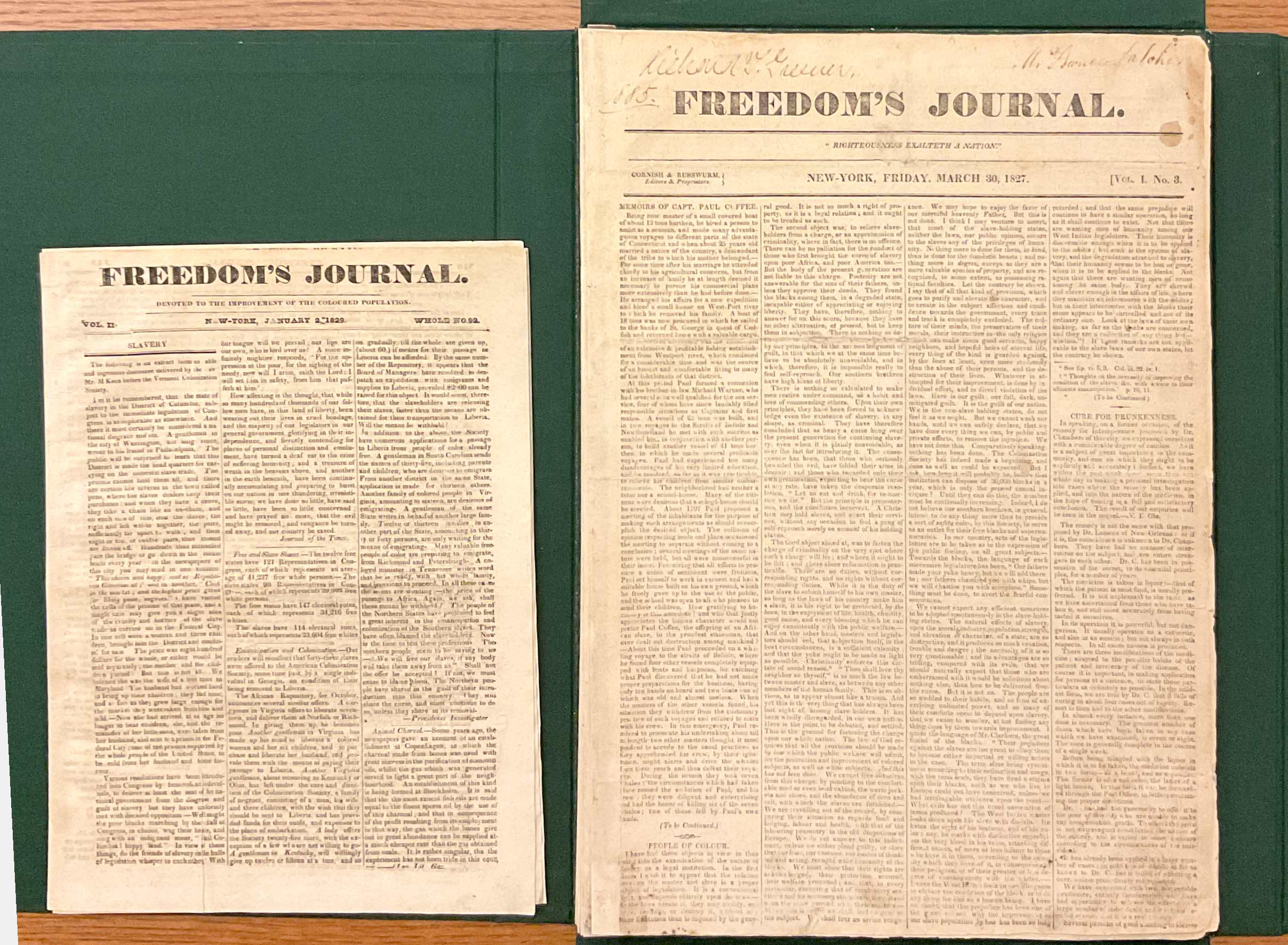
Courtesy of the New-York Historical Society.
I am the principal investigator of the “Freedom’s Journal and the Intermedial Power of Periodicals” project at the University of Graz, supported by a 2024–27 FWF Esprit Grant (504-G). The project investigates how Freedom’s Journal, the first African American–owned and –operated newspaper, functioned not just as a simple communicative document of one-dimensional printed words, but as a unique medial instrument that harnessed the power of (and tensions between) images, typography, reprint practices, spatial intertextuality, and printed content to produce radical cultural meanings. In particular, it focuses on the ways that the Journal’s mediality (and intermediality) contributed to its role as a cultural institution and its theorization and facilitation of nineteenth-century African American citizenship.
The project’s resulting monograph is titled Reading Between the Lines: Meaning and Mediality in Freedom’s Journal, which the University of Pennsylvania Press will publish in spring 2027. The book argues that Freedom’s Journal created provocative meaning not simply through its direct, expository texts (as scholars have already shown), but equally—and often more radically—through its content-medium relationship. Chapter 1 argues that the visuality of Freedom’s Journal was intimately linked to its projects of African American citizenship, thus telling a new narrative of Freedom’s Journal as a cultural institution attempting to balance economic concerns with socio-political ambitions, material constraints with medial expectations, editorial frustrations with audience appetites. Chapter 2 demonstrates how the Journal’s reprinting practices provided safe channels for engagement with revolutionary political thought. Chapter 3 explores the relationships between discrete printed items placed in spatial proximity to one another on or across the pages of Freedom’s Journal, asserting that this phenomenon produced a dialogic environment in which texts challenged, affirmed, and informed one another, ultimately producing an effect greater than the sum of each individual text. Knowing that the Journal was used pedagogically, Chapter 4 thinks through Freedom’s Journal as a learning tool focused on deconstructing white, Western hierarchies of power and oppression through unassuming texts and genres.